The first NetSuite quote is almost always wrong, and not because the sales rep is lying. It’s wrong because the quote covers the subscription for the modules in the demo, and the demo was built around a company that doesn’t look like yours. The NetSuite ERP system is broad, but every additional module, subsidiary, and custom record has a price. Buyers who budget from the first quote are usually surprised at renewal time.
I’ve sat in enough NetSuite planning meetings to recognize the pattern. Finance likes the consolidation. Operations likes the inventory visibility. IT likes that it’s cloud. Then the implementation partner scopes the work and the number doubles. The software is capable; the scoping is where projects go sideways.
What the NetSuite ERP System Includes
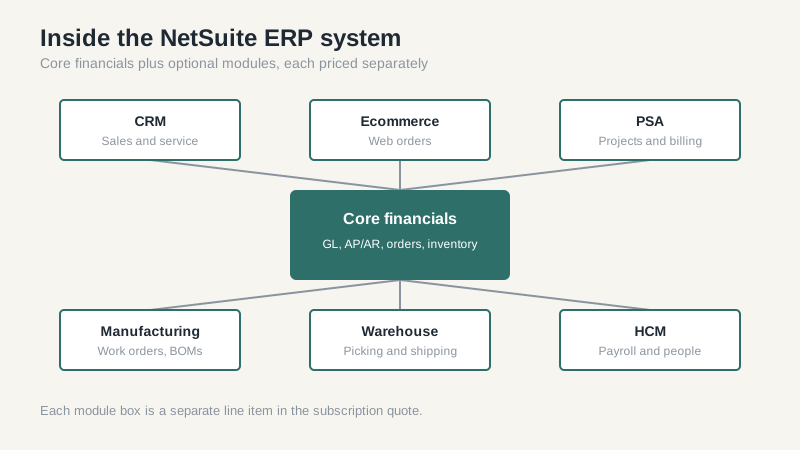
NetSuite started as a cloud financials product and grew by acquisition and module development. The core covers general ledger, accounts payable and receivable, order management, inventory, purchasing, and reporting. Around that core sit modules for CRM, ecommerce, professional services automation, manufacturing, warehouse management, and human capital management. Some are strong. Some are thinner than the sales deck suggests.
Manufacturing is the module buyers most often overestimate. NetSuite can handle work orders, bills of material, and routing at a basic level. If you run complex configure-to-order or process manufacturing with tight traceability, you’ll likely need add-ons or a different product. Warehouse management is similar: it works for straightforward fulfillment, but high-volume operations with wave planning and directed put-away often need a specialized WMS.
Subscription Math and the Renewal Cliff
NetSuite prices by user type and module, and the mix matters more than the headcount. A company with fifty warehouse users doesn’t pay the same as fifty finance users. The first-year quote often includes a promotional discount, and the renewal uplift can be steep. Ask in writing what the cap is on annual increases and what happens when the promotional term ends.
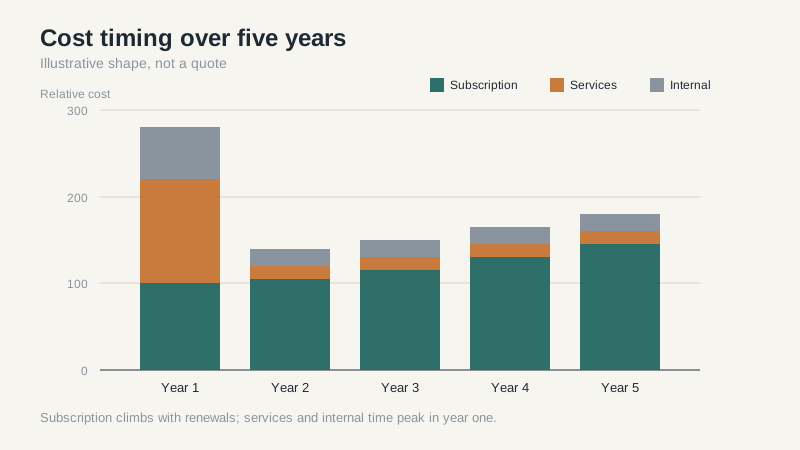
Then count the things that aren’t in the base subscription: sandbox accounts, extra storage, third-party SuiteApps, premium support, and implementation services. A useful exercise is to build a five-year cash model with three columns: subscription, services, and internal cost. Most buyers build only the first column and then treat the other two as surprises.
Budget for the first-year cash hit, not the average. Year one usually carries subscription, implementation, data work, and training at the same time, while the operational benefit arrives later. A model that spreads costs evenly across five years will make the first year look easier than it is.
Customization and the Upgrade Tax
NetSuite’s customization tools, SuiteScript and SuiteBuilder, are powerful. That’s the problem. It’s easy to build a custom record, a workflow, and a script for every exception, and each one becomes something the next administrator has to understand. NetSuite upgrades twice a year, and while custom code usually survives, custom processes often need retesting. Companies with heavy customization report spending a meaningful share of their admin time on regression testing.
The discipline I recommend is simple: customize the process only when the standard process genuinely costs more. Document every script and custom field with an owner and a business reason. Review the list annually and delete what nobody uses. The alternative is a system that works exactly the way the company worked in 2019 and can’t be changed without a project.
There’s a staffing angle too. NetSuite administrators are not cheap, and many mid-market companies try to run the system with a part-time finance analyst who has other responsibilities. That works for a while. It stops working when the company adds a subsidiary, changes its revenue recognition, or needs a new integration. Plan for a named owner with real time allocated, whether that person is internal or a managed service provider.
Where NetSuite Fits and Where It Doesn’t
The NetSuite ERP system fits best in multi-entity companies that need one cloud system across subsidiaries, especially services, software, wholesale, and light manufacturing. It’s also a reasonable fit for companies that expect to acquire businesses and want consolidation without installing servers. The U.S. mid-market sweet spot is roughly $20 million to $500 million in revenue, though plenty of smaller companies run it successfully.
Implementation timelines drift for the same reason. A single-subsidiary finance and inventory deployment might go live in four to six months. A multi-subsidiary rollout with manufacturing, CRM, and a new ecommerce site can take a year or more. The software doesn’t set that pace; the number of processes you change and the quality of your data do. Ask for a phase plan with dates and dependencies, and check it against your fiscal calendar. Going live during year-end close or peak shipping season is a decision you’ll regret.
It fits poorly when the business is highly seasonal with complex fulfillment, when manufacturing is the core differentiator, or when the company has no appetite for ongoing administration. NetSuite is not an install-and-forget product. Someone has to own the data, the integrations, and the twice-yearly release cycle.
If you’re comparing cloud options, our cloud ERP benefits piece covers the operational tradeoffs, and the Microsoft ERP options comparison is useful if you’re also considering Business Central.
Questions to Ask Before You Sign
Ask for the renewal terms, the uplift cap, and the exit clause. Ask which modules are included in the quoted user types and which are add-ons. Ask for an implementation reference in your industry that went live in the last two years, and ask that reference what the final cost was versus the initial quote. Ask who will administer the system after go-live and whether that person exists on your payroll today.
One more question that saves money: ask the partner to price a phase-one scope that covers only the processes causing the most pain. NetSuite implementations often fail by trying to replace everything at once. A narrower first phase gets you live sooner, gives the team a real system to learn on, and leaves the second phase to be scoped with actual knowledge instead of a demo script.
NetSuite is a good product with a sales motion that rewards optimism. The buyers who do well are the ones who scope narrowly, budget for administration, and treat the first quote as a starting point rather than a plan. If you can’t name the person who will own the system in year two, you’re not ready to sign.
