Odoo ERP demos better than almost anything else in its price band. A sales engineer can show inventory, manufacturing, accounting, and a website in twenty minutes, all from one login. The demo is real. The question is whether your company can run what you just saw.
I’ve seen Odoo work well for a 40-person job shop that needed better order tracking and a clean general ledger. I’ve also seen it turn into a science project for a 200-person manufacturer that kept adding community modules until upgrades became a monthly crisis. The difference was rarely the software. It was the partner and the scope.
What Odoo ERP is and what it isn’t
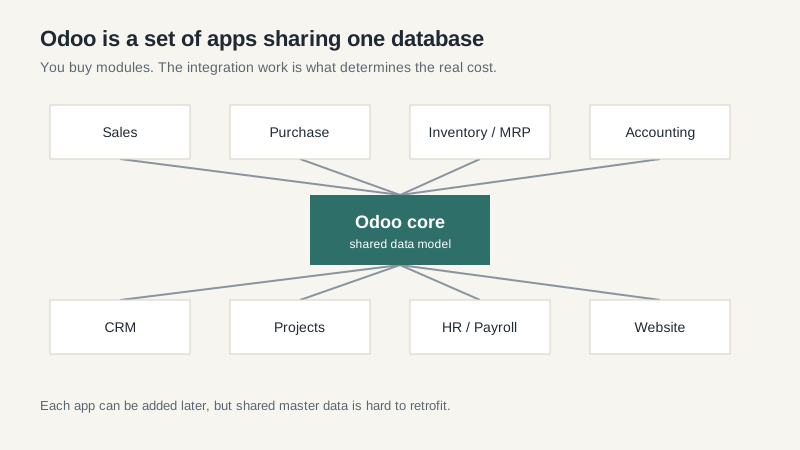
Odoo is a modular business application platform. The core includes sales, purchase, inventory, manufacturing, accounting, CRM, and project management, all sharing one database. You buy or install the modules you need, and the data moves between them without an integration project. That’s the appeal, and it’s a genuine advantage over stitching together five separate products.
It is not a deep vertical ERP. Manufacturing covers bills of materials, work orders, and basic scheduling. It does not replace a dedicated advanced planning system or a complex process-manufacturing suite. Accounting localization for U.S. sales tax and payroll works, but you’ll still need outside tools for payroll processing and tax filing in most states.
The community edition is free to install and genuinely capable. The enterprise edition adds support, hosting options, and features such as studio customization and full accounting. Most mid-market manufacturers end up on enterprise because the support and upgrade path matter more than the license savings.
Odoo ERP pricing in practice
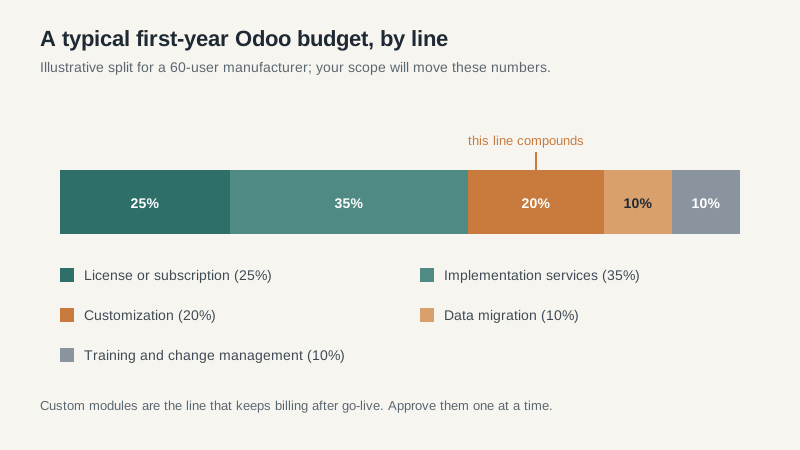
Odoo prices per user, per month, and the published tiers are lower than most competitors. A 60-user manufacturer might pay $20,000 to $40,000 a year for enterprise subscriptions, depending on the apps selected. That number looks great next to a six-figure on-premises license.
Implementation is where the budget moves. A competent partner will charge $40,000 to $120,000 to configure manufacturing, migrate data, train staff, and build the reports your team actually needs. Custom modules add more. A simple customization can take 40 hours; a complex one can take 400, and the estimate is often optimistic.
Hosting is another line. Odoo’s cloud hosting is convenient, but some companies run on their own servers to control cost or data location. That decision brings backup, patching, and security work back in-house. Price it honestly before you assume self-hosting is cheaper.
The partner dependency problem
Odoo’s partner network is uneven. Some partners are excellent: they know manufacturing, write clean code, and plan upgrades. Others are learning on your project. The Odoo brand doesn’t tell you which one you’re hiring, and the cheapest quote often comes from the least experienced team.
Ask how many Odoo implementations the partner has completed in manufacturing, not how many Odoo projects in total. Ask for a reference whose customization load resembles yours. And ask who will own your code after go-live, because custom modules are a maintenance obligation, not a one-time purchase.
Documentation is another gap. Odoo changes quickly, and community documentation lags. Your team will rely on the partner more than they would with a larger vendor. That’s fine if the relationship is strong. It’s expensive if the partner disappears or gets acquired.
Where Odoo ERP fits a manufacturer
Odoo fits job shops, make-to-order operations, and small assembly businesses with 20 to 150 users. It handles quotes, orders, bills of materials, purchasing, and inventory in one place, which is usually the core problem a growing manufacturer is trying to solve. The price lets a company buy capability it couldn’t afford from a tier-one vendor.
It fits less well when scheduling is genuinely complex, when multiple plants need consolidated planning, or when quality and traceability requirements demand a validated system. Those cases need a product with deeper manufacturing logic and a partner who has done it before. Odoo can be customized into that territory, but the cost advantage shrinks with every custom module.
Distribution is a decent fit if your catalog is straightforward and your warehouse processes are standard. Highly automated warehouses with conveyor controls and complex slotting will need integrations that Odoo doesn’t provide out of the box.
Upgrade and migration realities
Odoo releases a major version roughly once a year. Community edition upgrades are not automatic, and custom modules often break. Enterprise customers get more support, but the upgrade still requires testing and planning. Companies that skip two or three versions face a much larger project when they finally move.
Data migration from QuickBooks, legacy manufacturing software, or spreadsheets follows the same rules as any ERP project. Clean the item master, decide what history to keep, and assign owners. Odoo’s import tools are decent, but they won’t fix duplicate customers or inconsistent units of measure. The ERP software buying guide covers the cleanup sequence in detail.
Customization debt compounds. Every custom module is code your partner must maintain and retest. Before you approve one, ask whether a standard feature, a process change, or a report outside the system would solve the problem. The answer is often yes, and the savings show up at every upgrade.
One practical test: export a year of transactions from your current system and try to import them into a demo. Watch how long it takes to map units of measure, payment terms, and tax codes. If that exercise takes a week in a demo, it will take a month in production.
A blunt test before you choose Odoo
Count the processes you’d need to customize. If the number is small and your partner has manufacturing references, Odoo is a sensible, cost-effective choice. If the number is large, the subscription price is a distraction; you’re really buying a custom software project with an ERP attached.
Ask the partner to upgrade a customized demo instance in front of you, not a clean one. Ask what happens to your custom modules when the next major version ships. Then compare the five-year total against a mid-market suite such as Sage ERP, including implementation and internal time. Odoo often wins on year-one cash. Whether it wins over five years depends on how much code you add and how well your partner maintains it.
