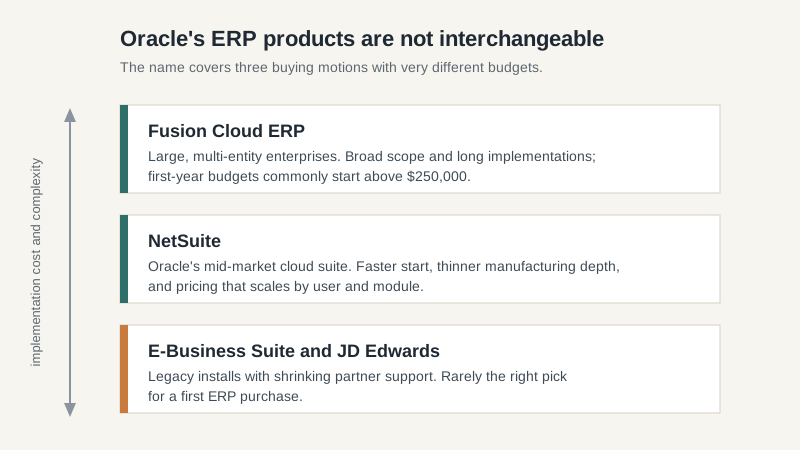
The Oracle ERP name covers at least four products, and the first job is figuring out which one the sales team is actually quoting. I’ve sat in meetings where a buyer thought they were pricing NetSuite and the proposal came back for Fusion Cloud ERP at four times the number. Nobody was lying. The account executive had simply moved the deal upmarket.
That ambiguity is the defining feature of buying Oracle as a mid-market company. The software is capable. The sales motion is built for larger deals, and the vocabulary shifts depending on who owns the account.
The Oracle ERP products you’ll actually be quoted
Fusion Cloud ERP is the flagship: financials, supply chain, manufacturing, and human capital in one cloud stack. It’s built for multi-entity enterprises with dedicated IT and a tolerance for long programs. A $150 million manufacturer can run it, but the first-year budget often starts around $250,000 and climbs with scope.
NetSuite is Oracle’s mid-market cloud suite, and it’s the one most buyers between $20 million and $300 million should evaluate first. Financials are strong, multi-entity consolidation is solid, and the partner ecosystem is deep. Manufacturing is adequate for light assembly and weak for complex routing and shop-floor control. The NetSuite ERP system guide covers that tradeoff in more detail.
E-Business Suite and JD Edwards are the legacy on-premises products. They still run plenty of U.S. manufacturers, and Oracle continues to support them, but new implementations are rare. If a partner pitches either one for a first ERP purchase, ask why. The answer is usually that the partner’s practice is built on it.
What Oracle ERP costs in the mid-market
List pricing is close to meaningless here. Oracle quotes by module, user count, and edition, then discounts aggressively at the end of a quarter. I’ve seen the same NetSuite scope quoted 30% apart by two partners in the same month. Treat the first number as an opening position, not a budget.
For a 100-user manufacturer, a NetSuite implementation with financials, inventory, and light manufacturing typically lands between $150,000 and $350,000 in year one, including services. Fusion Cloud ERP for a similar headcount but multiple entities can run two to four times that. The gap isn’t only license cost; it’s the consulting hours required to configure a broader product.
Renewals deserve attention. Oracle’s cloud contracts often include annual uplifts, and adding modules later costs more than buying them at signing. Ask for a five-year schedule in writing, including support, and model a 5% to 7% annual increase. If the vendor won’t put the schedule in the proposal, assume the worst case.
Where Oracle ERP implementations lose time
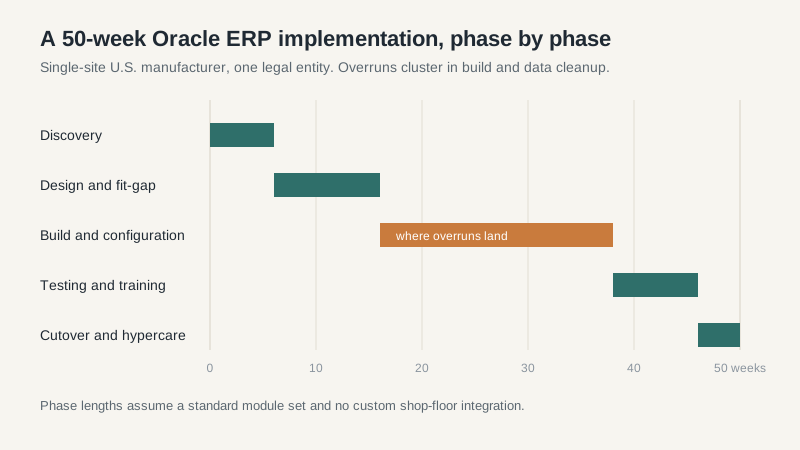
Data migration is the usual suspect, but Oracle projects have a second problem: too many options. Fusion and NetSuite both allow extensive configuration, and a partner who wants to prove expertise may configure instead of asking whether the process should change.
I watched a project spend eleven weeks on a custom commission calculation that the sales team ultimately abandoned. The standard module would have handled 90% of it. That’s not an Oracle-specific failure, but the product’s flexibility makes it easier to indulge.
Testing is the other trap. Oracle’s quarterly updates can touch workflows you rely on. If your team doesn’t have a sandbox and a regression checklist, every release becomes a small emergency. Budget for a part-time administrator, not a rotating cast of IT generalists.
NetSuite is Oracle’s mid-market answer, with caveats
NetSuite gets most of the mid-market attention, and mostly for good reason. A distributor with a few hundred employees can run financials, order management, and inventory on it without a data center. Reporting is decent out of the box, and the partner pool is large enough that you can replace a bad one.
The caveats are real. Per-user pricing punishes companies with many occasional users. Customization uses SuiteScript, which means you need a developer or a partner on retainer. And the manufacturing module is not a substitute for a dedicated MES or a deep MRP engine. If your shop floor runs complex assemblies, test the fit before you fall for the demo polish.
Contract terms that matter more than the demo
Oracle contracts are long and written to favor Oracle. The parts that hurt mid-market buyers are price escalation, module packaging, and the definition of “production” users. A warehouse scanner license and a full finance seat may be priced differently, and the rules can change at renewal.
Ask for the right to reduce user counts at renewal, not only add them. Ask what happens if you sell a division and need to split the contract. And get the data export terms in writing, including format and cost. I’ve seen a company pay a five-figure extraction fee for records it had already paid to store for six years.
Service credits sound reassuring until you read the exclusions. Uptime commitments often exclude scheduled maintenance and third-party integrations, which is where most outages actually show up. Read the support tier definitions before you assume you’re buying 24/7 coverage.
A blunt Oracle ERP shortlist test
Before you take a Fusion or NetSuite demo, read the ERP software buying guide and answer three questions. How many legal entities need consolidated reporting? How many users will touch the system each day, including warehouse staff who only scan? And which processes are genuinely differentiating versus merely annoying?
If the answers are one entity, under 150 users, and standard manufacturing, NetSuite through a strong partner is usually the sensible Oracle option. If you have a dozen entities and a global roll-up, Fusion may justify its cost. If you have a legacy E-Business Suite install and no compelling reason to move, extending its life for two more years may beat a rushed cloud migration.
Get the proposal broken into license, services, and estimated change orders. Ask which modules are included in year one and which will be quoted again at renewal. Then ask the partner for two references at your revenue level, not their largest logo. The reference call will tell you more about the implementation than the demo ever will.
